


Your shopping cart is empty!
Tomato "Moskvich"
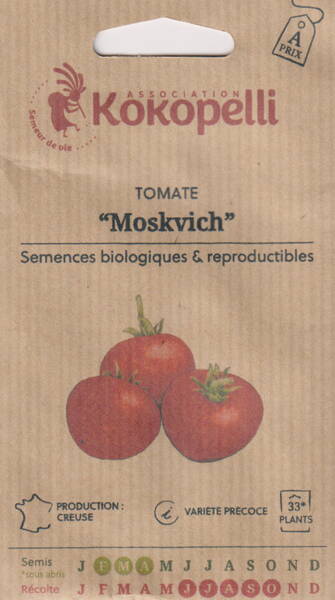
Eco seeds
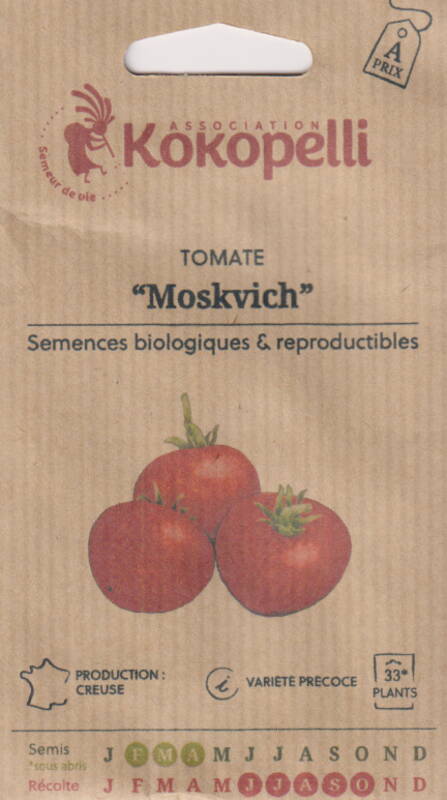
Tomato "Moskvich".
Does not require pruning (pinching).
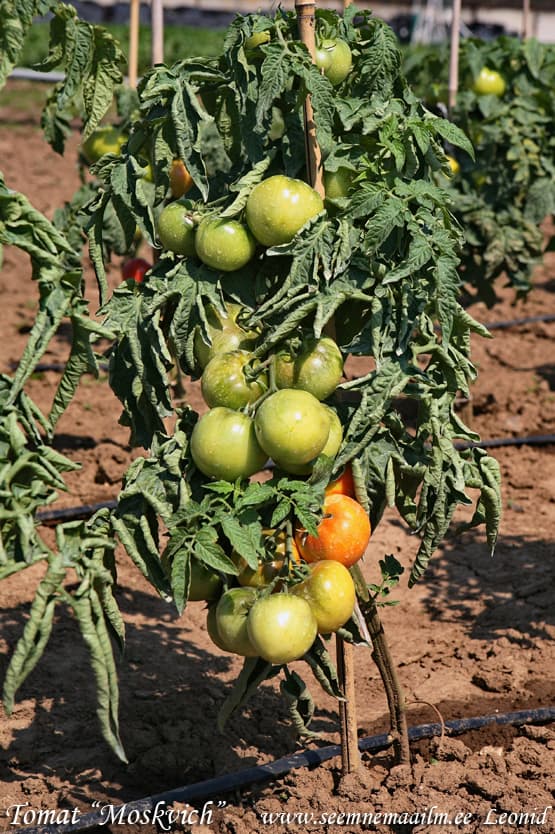
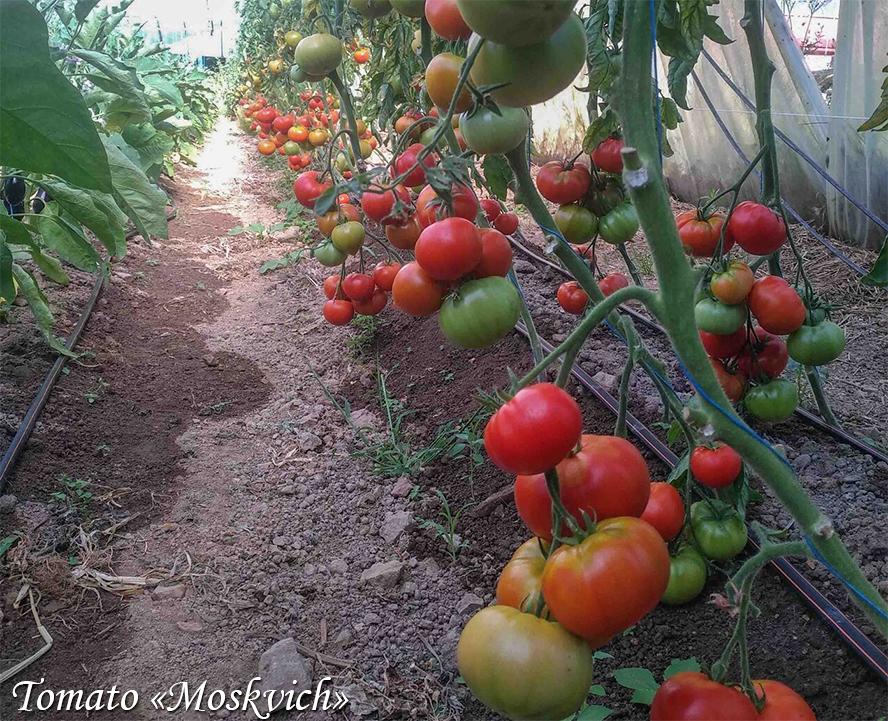
An early-ripening variety (fruit maturation occurs in 95-100 days). The plant is determinate, with medium foliage. The truss is simple, compact, with 6-7 fruits per truss, suitable for fresh consumption, pickling, and canning.
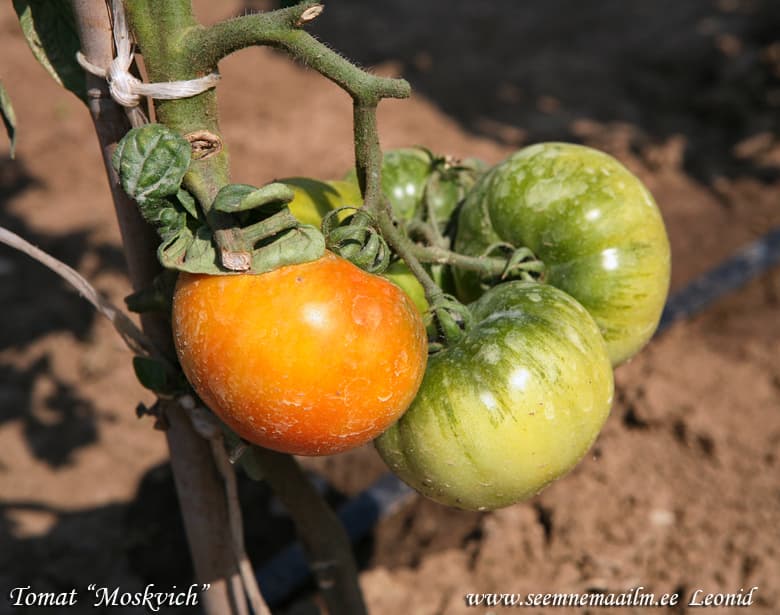
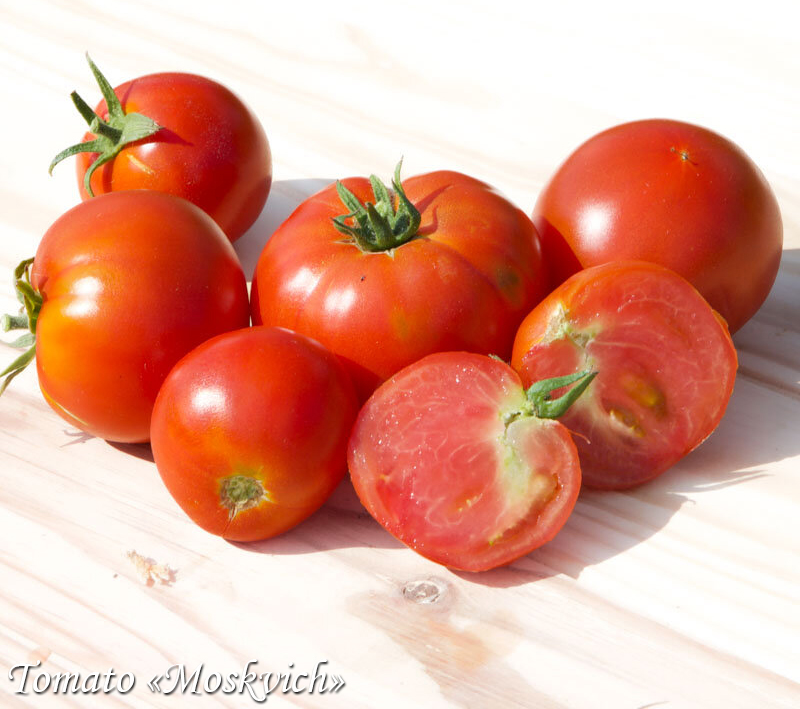
The variety is highly productive, setting fruit well even under adverse conditions. It is resistant to Fusarium, Verticillium wilt, Alternaria, and rot. Recommended for outdoor cultivation. The plant is compact, a standard bush type, 40-65 cm tall. It requires little to no pruning. The fruits are round, medium-sized, weighing 55-75 g, with the first ones reaching up to 80-120 g, and have excellent taste qualities.
Value of the variety: early and simultaneous fruit formation, cold resistance, tolerance to temperature fluctuations, and high fruit set under unfavorable weather conditions.
It does not require pruning, and thanks to its early ripening, the fruits mature before the onset of late blight. It is resistant to adverse growing conditions (including sharp temperature drops). The variety grows well in dense plantings. The yield of marketable fruits is 1.5-4.5 kg/m².
Texture: firm.
Color: red.
Foliage: regular.
History: This famous Russian heritage variety was bred in the early 1970s at the N. I. Vavilov Institute of General Genetics in Moscow.
Does not require pruning (pinching).
An early-ripening variety (fruit maturation occurs in 95-100 days). The plant is determinate, with medium foliage. The truss is simple, compact, with 6-7 fruits per truss, suitable for fresh consumption, pickling, and canning.
The variety is highly productive, setting fruit well even under adverse conditions. It is resistant to Fusarium, Verticillium wilt, Alternaria, and rot. Recommended for outdoor cultivation. The plant is compact, a standard bush type, 40-65 cm tall. It requires little to no pruning. The fruits are round, medium-sized, weighing 55-75 g, with the first ones reaching up to 80-120 g, and have excellent taste qualities.
Value of the variety: early and simultaneous fruit formation, cold resistance, tolerance to temperature fluctuations, and high fruit set under unfavorable weather conditions.
It does not require pruning, and thanks to its early ripening, the fruits mature before the onset of late blight. It is resistant to adverse growing conditions (including sharp temperature drops). The variety grows well in dense plantings. The yield of marketable fruits is 1.5-4.5 kg/m².
Texture: firm.
Color: red.
Foliage: regular.
History: This famous Russian heritage variety was bred in the early 1970s at the N. I. Vavilov Institute of General Genetics in Moscow.
* What tomatoes do not like:
...growing in shaded areas, as they require intense sunlight to form a good harvest.
...low temperatures: at +10°C the growth of this crop stops, and at +15°C — flowering stops.
...proximity to potatoes — they get infected with late blight from the latter.
Pay attention! To prevent the seedlings from stretching out after emergence, place them in the brightest spot and lower the temperature (for 4-7 days) during the day to +12...+15°C, and at night to +8...+10°C. Water the mulch in the tomato plantings with a fertilizer mixture or urea. This will reduce the need for loosening; nutrients and heat are distributed more evenly: the soil warms up well during the day and doesn't cool down as fast at night. Do not apply fertilizers containing chlorine. Do not take long breaks between watering, as sudden sharp waterlogging after a drought causes fruits to crack.
Just imagine! Rupture of the fruit tissues can also occur with the excessive simultaneous removal of lower leaves, when evaporation through the leaf surface decreases, and the rate of water accumulation in the fruits increases. It is better to remove no more than two or three leaves at a time. In greenhouses and hotbeds, fruits can crack due to a sharp drop in temperature at night and high humidity. Under these conditions, evaporation worsens, and water accumulation in the fruits is enhanced.
Take note! Under unfavorable growing conditions, flowers may fall off. The main reasons for this are:
* low temperatures of soil, air, and irrigation water;
* high (over 60-75%) air humidity, when the anthers do not crack, and damp pollen does not spill out for pollination; with waterlogging, fruits are also affected by brown spot, late blight, and blossom end rot;
* high night temperatures (insufficient outflow of nutrients from the leaves due to increased expenditure on respiration);
* phosphorus deficiency and low lighting (seedlings stretch out, quickly turn pale, the flower is not provided with nutrition);
* planting overgrown seedlings;
* overhead sprinkler irrigation;
* excess nitrogen with a lack of phosphorus and potassium;
* magnesium deficiency (potassium magnesium sulfate is applied if there is a lack of magnesium).
Furthermore! Good results when flowers drop are achieved by spraying with a boric acid solution (1 g per 1 liter of hot water). In fact, this is a foliar feeding with boron. After 2 days, the spraying is repeated. The second time, the plants can be sprayed either with a boric acid solution or an ash solution (2 cups per bucket of water). If the tomato seedlings have stretched out, planting them in a permanent place is not very convenient, but you can derive some benefit from this. If the stem stripped of leaves (leaves are left only on the upper part of the stem 10-15 cm long) is planted at an angle and the bare part of the stem is covered with soil, this stimulates the growth of additional roots.
It is best to cover the stem with a specially prepared soil mixture (50% humus, 45% peat or turf soil, and 5% ash); water the plants with a warm solution of potassium permanganate (2 g per 10 liters of water). After 2 days, the upper part is bent upwards and tied to a peg or a vertically stretched string.
When caring for such tomatoes, it should be remembered where their main and additional root systems are located in the garden bed, so as not to damage them during loosening, and not to leave them without water and nutrition during watering and feeding.
What if the fruits do not set? One of the reasons for this phenomenon may be insufficient pollination of the flowers. This is especially common for tomatoes in greenhouses, where there is no wind, and the plants stand completely still. For better fruit setting, the plants are shaken in the morning or gently tapped on the stem, or the trellis twine is pulled.
For flower pollination to occur smoothly, the air humidity in the greenhouse should not be higher than 70%, and the temperature — not higher than +30°C (the greenhouse is ventilated periodically).